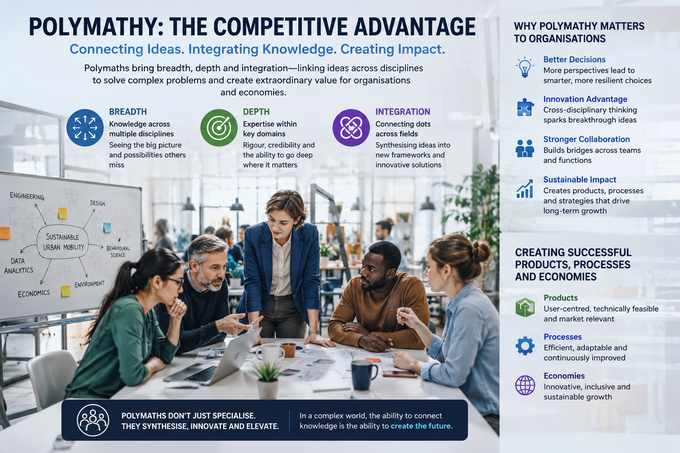
In my approach to polymathy, it is not restricted to a characteristic of individuals. A team, organization, leadership system, governance arrangement, or even AI can also be less or more polymathic when it develops the three qualities (breadth, depth, and integration) in how it pursues, develops, and applies knowledge.
The extension brings into the conversation several adjacent traditions in understanding knowledge acquisition and its mobilization: the dynamic-capabilities literature; Bob and Michele Root-Bernstein’s intuitive tools for thinking; and research on sensemaking, organizational learning, ambidexterity, among others.
The new figure therefore adds a second layer. The polymathic architecture can support key dynamic capabilities such as:
- Problem (re)framing
- Rhizomatic learning
- Enmathetic translation
- Critical openness
These capabilities matter because organizations rarely confront clean, self-contained problems. They confront interdependent challenges, incomplete information, conflicting interpretations, and shifting conditions. Under such circumstances, the value of polymathy may lie partly in enabling entities to develop distinctive vantage points, recognize opportunities that a narrower frame would miss, and renew themselves without abandoning the expertise on which they depend.
It is important to highlight that this conversion into powerful outcomes is not automatic! Breadth, depth, and integration do create the affordances but a lot of work, trial and error, and adjustment is necessary to make it run productively—some entities will, in fact, not be ready from scratch!
In sum, I am sharing this second figure because it contains the broader proposition I am developing for organizations: polymathy may be relevant not only to how people learn and create, but also to how organizations and institutions organize knowledge for action.
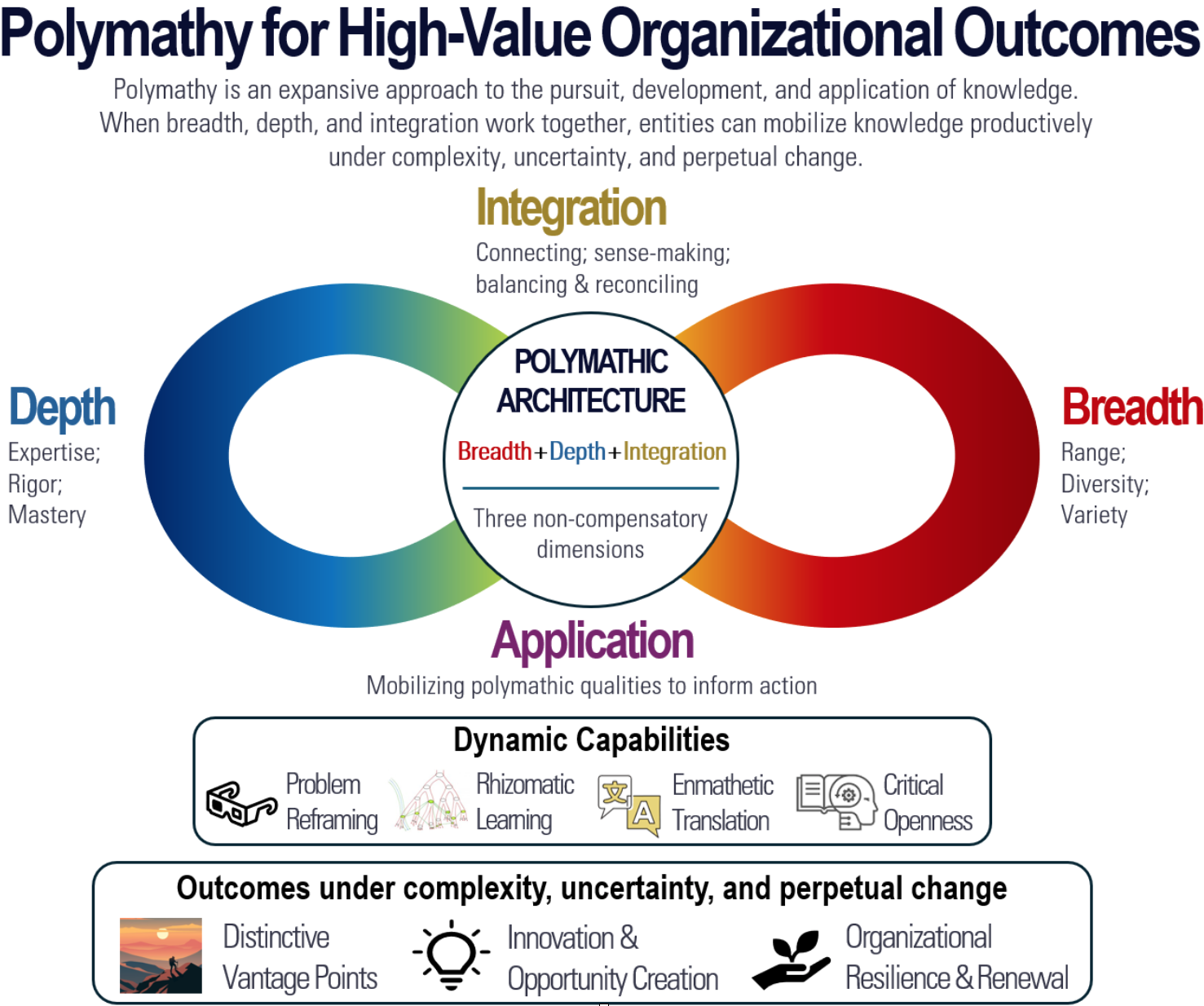
Polymathy for high-value organizational outcomes